The ROME PROJECT
Washington public life in the age of artificial intelligence
I. Purpose and Direction
The Rome Project proposes beautiful public gathering places across Washington State as part of a long-term response to artificial intelligence and the changes it may bring to work, income, leisure, and belonging. These would be marvelous places in which to spend ordinary life: generous halls, gardens and courtyards, spaces for sport and entertainment, food and conversation, and rooms for learning and public debate. Along with the Athens Project, the Rome Project seeks to generate a new era of public life – providing beauty, meaning and entertainment for all social groups and identities together while building a stronger and more synchronized state and nation.
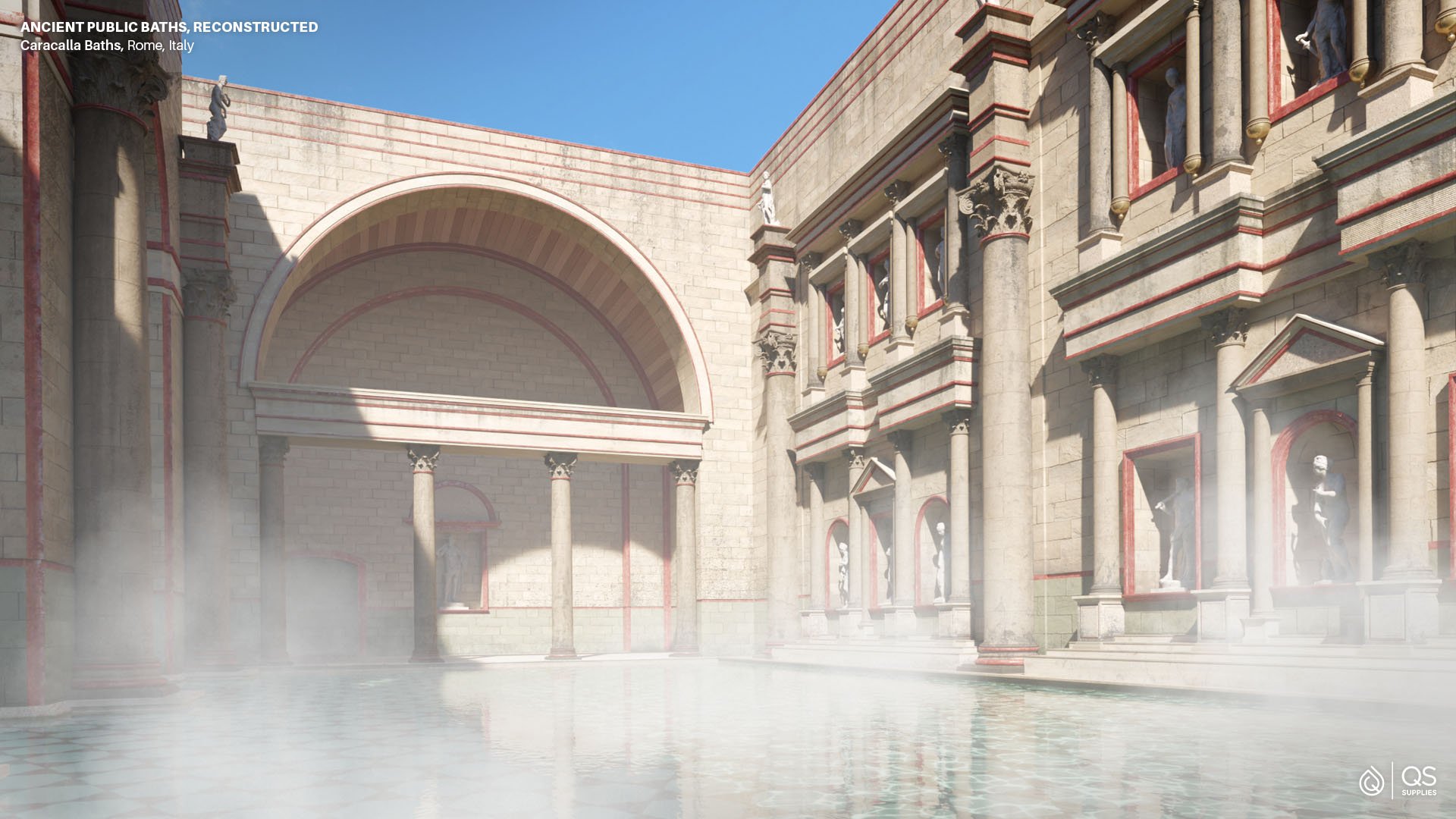
The spirit central to the Rome Centers are those of the historical “public baths” in Classical Roman Antiquity – where members of all social stratum would gather to debate, relate, exercise, view entertainment, and share in glory of Rome.
Its tentative financial premise is that Washington could devote a portion of increased public revenue arising from AI-driven economic growth to shared civic infrastructure. The revenue mechanism remains to be determined.
This is a vision for development through consultation, feasibility studies, and pilots. Its geographic reach and timetable would depend on sustainable funding and demonstrated public use.
II. Preparing for AI Disruption
The pace and extent of AI disruption remain uncertain. Washington should prepare for several possibilities: tools that improve existing jobs, changes to entry-level career paths, displacement in particular occupations, and larger shifts in the relationship between paid work and everyday life. These are planning scenarios, not predictions of inevitable mass unemployment.
Employment often provides routine, recognition, social contact, and a sense of contribution as well as income. If work becomes less stable or working hours change, financial assistance alone may not replace those functions. Public gathering places could help residents maintain relationships, learn useful skills, organize activities, debate and exchange ideas, explore politics and policy, and take part in shared projects.
III. Beauty as a Public Good
Rome centers should be places of genuine architectural distinction. Beauty would be part of their public purpose,
An architectural language rooted in Western civic traditions
Design would draw on the classical and humanist traditions of Western civilization.
This tradition could be interpreted through Washington materials, landscapes, and craftsmanship. Timber, masonry, planting, daylight, and sheltered outdoor spaces could connect civic grandeur to the Pacific Northwest. Design competitions would welcome thoughtful contemporary interpretations that preserve the underlying commitment to harmony, craft, and lasting public value.
A shared inheritance open to everyone
These would be places where a mechanic, nurse, lawyer, apprentice, business owner, student, and retiree might find themselves at the same table. The building would confer the same welcome on each. Neither income, credentials, occupation, nor the purchase of an expensive membership would determine who belongs.
Like the great communal settings that inspire the project, Rome centers would make encounter part of daily life. Different fortunes and experiences would meet through ordinary pleasures: a game, a meal, a performance, a conversation. Their architecture would express a common civic inheritance available to all Washington residents.
Build for use and endurance
Beauty would be evaluated alongside accessibility, acoustics, energy demand, weather protection, maintenance, and robust AI and human driven security measures. Durable materials and skilled construction would be weighed against full lifecycle costs.
IV. Life Within a Rome Center
The commons and gardens
A central commons would offer comfortable seating, communal tables, quieter areas, and space to linger without buying anything. Gardens, sheltered terraces, or courtyards could extend the gathering space. Clear information and welcoming staff would help a newcomer find an activity without needing an existing social circle.
Playing and watching sports
Facilities could include basketball courts, fitness rooms, table tennis and pool, accessible recreation, casual drop-in activities, and community leagues. A separate viewing hall could bring residents together for major professional, college, international, and local sporting events.
Food and entertainment
Affordable food stalls, a café, and communal dining could sit alongside live music, comedy, film screenings, games, exhibitions, and resident-led events. Transparent vendor selection and manageable stall sizes could create opportunities for local businesses. Buying food would not be a condition of admission to common areas.
Water and restoration
Where feasible, pools, saunas, or soaking facilities could recall the bathing traditions that inspired the project. These would require their own assessment of construction, energy, hygiene, privacy, accessibility, staffing, and ongoing cost. They would be optional rather than a requirement for every center.
Learning and public discussion
Flexible rooms could host practical workshops, reading groups, repair sessions, speakers, and debates. Quiet and active uses would be acoustically separated. Programs could be offered by community partners.
Independent spaces and integrated experiences
A resident could spend an evening moving among activities or enjoy just one. Civic participation would remain voluntary. Facilities would accommodate families, individuals, and informal groups, including people who prefer quieter company. Their character would emerge from regular use rather than a requirement that everyone follow the same itinerary.
V. Public Engagement and the Athens Connection
The Rome Project would give public engagement an enduring physical home. Discussion could occur informally over a meal or through organized forums, public lectures, structured debates, and resident associations. Facilities would make room for intellectual curiosity and disagreement as well as recreation.
VI. Funding and a Measured Path Forward
The tentative AI revenue proposal
The central funding idea is to dedicate a portion of increased Washington public revenue associated with AI-driven economic growth to civic renewal, including Rome centers. Possible mechanisms include an appropriation from realized revenue growth or a future legislatively established AI prosperity fund. The source, rate or share, eligibility rules, and allocation method are to be determined through fiscal analysis and public deliberation.
Attributing revenue growth specifically to AI would be difficult. A proposal would therefore need a transparent baseline, an independent forecasting method, and rules that distinguish recurring revenue from temporary gains. Increased company profits, economic output, and state tax receipts are different measures. None would automatically establish that money is available for this program.
Funding that can support an open building
State and local appropriations, grants, philanthropy, affordable fees, rentals, and vendor leases could supplement a future AI-related allocation. No particular tax or revenue instrument is selected in this paper. Funding proposals would be assessed for stability, fairness, administrative cost, and consistency with other public obligations.
Each center would separately budget acquisition and construction, annual operations, maintenance, major replacement, and contingencies. One-time revenue could fund suitable capital costs, but recurring services would require recurring support. Verified productivity savings could contribute only when they actually release budget resources without undermining service quality.
An enduring public ambition
The Rome Project would begin a new era of public engagement by giving technological progress a visible civic expression. Its promise is a Washington where shared prosperity can be experienced in beautiful places, open doors, familiar faces, and opportunities to participate. As the economy changes, residents would have places worthy of the lives they wish to build together.